Most SEO tools are built for SEO specialists. They throw thirty metrics at you on the first dashboard, assume you already know what a Domain Rating is, and bury the actually-useful actions under five layers of menus.
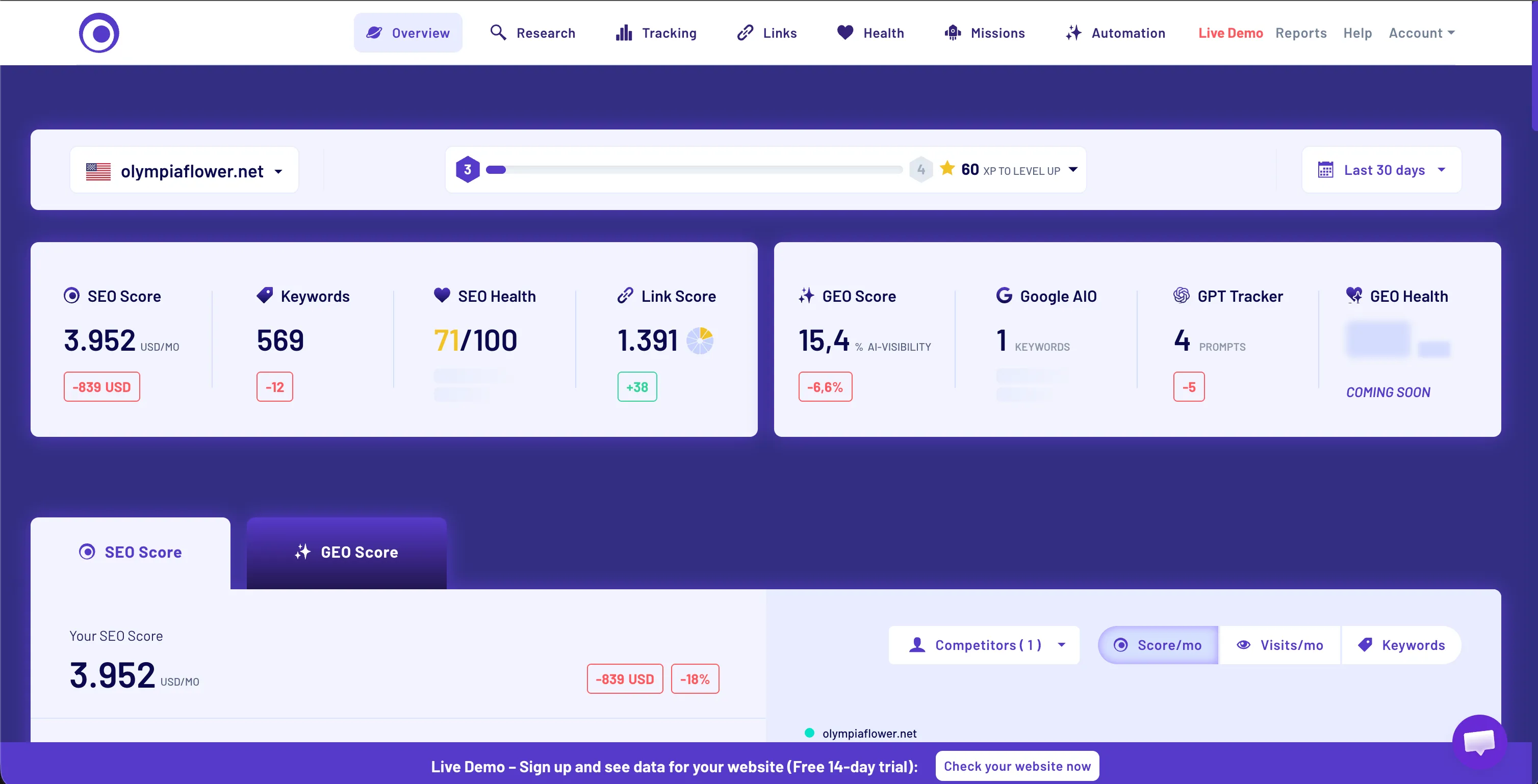
Morningscore went the other direction. It looks more like an RPG than a marketing dashboard — there is a Health score, missions to complete, XP, and a friendly fox named Morris explaining things in plain language. Underneath the playful interface is a real SEO toolkit: keyword rank tracking, backlink monitoring, technical audits, competitor analysis, and a growing set of AI-driven features for the new generative-search era.
After using it across a few projects alongside the bigger names, here is an honest read on what it does well, where it falls short, and who it actually fits.
What Morningscore Actually Does 🛠️
Morningscore bundles the four things most small businesses and freelancers need from an SEO tool into a single dashboard:
- Keyword tracking — daily ranking checks for the keywords you care about, with traffic value estimates in real money rather than abstract scores.
- Backlink monitoring — alerts on new and lost links, anchor text breakdowns, and a trust-weighted view of your link profile.
- Site health audits — a technical crawl that flags broken links, missing meta tags, slow pages, and crawlability issues.
- Competitor analysis — side-by-side keyword and backlink comparisons against any domain you point it at.
- AI assistant and GEO features — content suggestions tuned for both classic SEO and generative-engine visibility.
The genuinely distinctive move is wrapping all of this in a single Health score (0–100) and a missions list of concrete next actions. You log in, you see one number, you see three things to do. That is the entire onboarding experience, and it is hard to overstate how much friction it removes for non-specialists.
The Health Score and Missions 🎯
The Health score is a weighted composite of your keyword rankings, backlink trust, and technical SEO state. On its own a single SEO score is, frankly, a marketing device — it is not a number you can pin a forecast to. But Morningscore uses it well as a direction-of-travel signal: if your Health drops 8 points in a week, something happened, and the missions panel will usually tell you what.
Missions are where the gamification earns its keep. Instead of dumping 400 issues on you, Morningscore picks a handful that actually matter, ranks them by estimated traffic impact, and presents them as tasks you tick off. "Add an internal link from /pricing to /features." "Reach out to domain — they linked to a competitor's similar page." "Target the keyword X on page Y; you are ranking #14 with a small push needed."
It is the same data Ahrefs would show you, surfaced as a to-do list instead of a report. For a founder who has 30 minutes a week for SEO, that framing is the difference between progress and paralysis.
Where the Data Actually Stands 📊
Let's be direct about the elephant in the room: Morningscore's keyword and backlink index is smaller than Ahrefs or Semrush. This is unavoidable — those tools have spent a decade and tens of millions of dollars on crawl infrastructure. Morningscore is a smaller, independent European company.
What does that actually mean in practice?
- Keyword rank tracking is solid. Once you tell Morningscore which keywords matter, daily tracking is accurate and reliable. This is the same job as the big tools.
- Keyword research has fewer ideas at the very long tail. Searching for established commercial keywords gives you good volume and difficulty data. If you go very deep into niche long-tail discovery, you will find more ideas in Ahrefs.
- Backlink discovery is comparable for any domain that matters. Links from real, indexed sites show up. The gap is in obscure directories, scraped pages, and very low-quality links — which most users do not need to track anyway.
- Technical audits are clean and prioritized. No frills, but it catches the things that actually move rankings.
For 80–90% of small business SEO work, this is genuinely enough. If you are running enterprise SEO across thousands of keywords and need the deepest possible link index, you will outgrow Morningscore. That is a real ceiling, and it is worth being honest about it.
The AI and GEO Side 🤖
Morningscore has been actively building out features for Generative Engine Optimization (GEO) — the practice of optimizing for visibility inside AI search experiences like ChatGPT, Google AI Overviews, and Perplexity.
The AI assistant inside the tool will help you draft content, suggest topical clusters, and increasingly evaluate pages for AI-search readiness: clear answer paragraphs, structured data, entity coverage, and the kind of citable phrasing that LLMs tend to surface.
This is an area every SEO tool is racing on right now, and Morningscore is moving faster than most. Whether their GEO features beat what you can get out of ChatGPT directly is a separate debate — but having it integrated next to your keyword and ranking data, rather than in a separate tab in another browser, is genuinely useful.
We go deeper on the GEO topic in our generative engine optimization guide.
Pricing and Plans 💰
Morningscore's pricing structure is straightforward and undercuts the major US tools meaningfully. Plans scale by the number of keywords tracked and projects monitored, and there is a 14-day free trial with no credit card required.
For context: the lowest paid Morningscore plan is roughly comparable in price to a single Ahrefs add-on, and it includes all of keyword tracking, audits, backlinks, missions, and the AI features. For a freelancer or small in-house marketer, this is the kind of pricing where you can actually justify the line item.
What You Give Up vs Ahrefs/Semrush
Being honest about the trade-off:
What you lose
- Index depth. Long-tail keyword volume and very obscure backlinks are thinner.
- Power-user filtering. Ahrefs has 10 filters on every report; Morningscore has 2. For specialists this is a downgrade.
- Raw API access. Morningscore's API is more limited than Ahrefs' if you build custom dashboards.
What you gain
- Time. Onboarding is genuinely 10 minutes. You will not spend a Saturday learning the tool.
- Actionability. Missions are a real productivity feature, not a gimmick.
- Price. Often less than half of the equivalent Ahrefs tier.
- A friendlier interface for clients. If you share the dashboard with non-SEO stakeholders, they will not bounce off it.
Who Morningscore Actually Fits 👤
After using it, the user profile is pretty clear:
- Founders and solo operators who need to know whether SEO is working without becoming SEOs.
- Freelancers and small agencies managing 5–30 client sites, where Ahrefs' per-seat pricing is painful.
- In-house marketers at SMBs who do SEO as one of five jobs and need a dashboard they can present to a non-technical CEO.
- Content teams who want keyword and competitor data without a separate tool stack.
It is not the right fit for:
- Agencies whose entire pitch is enterprise-grade SEO research depth.
- Sites tracking 5,000+ keywords or doing serious backlink prospecting at scale.
- Specialists who already live in Ahrefs and have built their workflow around its filters and exports.
Pairing Morningscore with Sitecheck 🔗
Sitecheck covers technical health, performance, accessibility, security, and uptime — the engineering side of how your website actually behaves. Morningscore covers the SEO side: rankings, keywords, links, and search visibility.
They complement each other directly:
- Sitecheck flags the technical issues (slow LCP, broken meta, accessibility blockers, security headers) that quietly eat into the SEO performance Morningscore measures.
- Morningscore flags the keyword and link opportunities that Sitecheck audits cannot see.
- Together they give you both halves of the loop: "is the site technically sound?" and "is the site ranking and growing?"
A simple workflow: run a Sitecheck scan to clean up the technical side, then watch your Morningscore Health score and keyword positions improve over the following weeks as the search engines re-crawl.
The Bottom Line
Morningscore is not trying to be the deepest SEO tool in the world. It is trying to be the SEO tool that small businesses and freelancers actually use — and on that goal it succeeds clearly.
If you have ever opened Ahrefs, felt overwhelmed, and closed the tab, this is the tool that will probably stick. If you are a seasoned SEO professional running enterprise campaigns, you will hit its ceiling, and you should know that going in.
For everyone in the middle, which is most websites on the internet, Morningscore is one of the easiest SEO investments to justify in 2026.
Start with the free 14-day Morningscore trial — no credit card needed — and run a free Sitecheck scan to clean up the technical foundation while you are at it.